

Built for the Vendée Globe 2012, Einstein created quite a stir due to her great speed, but the IMOCA 60 yacht – originally named Acciona – capsized during the race in 2013. A little under ten years later, following extensive repair and redesign, Einstein won The Ocean Race Europe in June 2021. This remarkable turn-around in fortunes was made possible by the close partnership forged between the boat’s owners, Offshore Team Germany (OTG), designers and architects Owen Clarke Design, the Trimarine shipyard in Lisbon and engineering consultancy STRUCTeam.
Designed by Owen Clarke Design for the 2012 edition of the Vendée Globe, Acciona was a showcase for sustainable technologies and relied on solar, wind and water-power to drive her electronics and hydraulics. Further, she was fast. The IMOCA 60 yacht achieved great speeds over certain passages of the single-handed, non-stop, round-the-world race, creating quite a stir among observers.

Acciona’s race, however, ended prematurely. On the morning of 3rd February 2013, while she was negotiating the North Atlantic, the skipper triggered her distress beacons. Search and rescue teams sent to investigate found him in his life-raft and Acciona capsized, her keel broken. The skipper was quickly rescued by helicopter, but Acciona spent several weeks in the ocean before being recovered. Her bruised and battered hull was then put in storage in Majorca, where it languished for five years, before an enterprising team of managers, designers and engineers found her, and brought her back to life.
Opportunities
At the beginning of 2017, when the Manager of Offshore Team Germany (OTG), Jens Kuphal, heard about the plight of Acciona, he sensed an opportunity.
IMOCA 60 racing yachts are among the fastest, most modern monohulls in the world. It is tempting to describe them as the marine equivalents of Formula 1 cars, but they probably have more in common with Paris–Dakar rally cars; IMOCA 60 yachts must not only be fast, but they must also withstand the harshest of conditions.

Unsurprisingly, entering the IMOCA 60 class with a new boat can be an eye-wateringly expensive endeavour, but for OTG, Acciona represented an affordable way in. Kuphal says: “The budget for the building of [Acciona] was extremely high. It was a high-profile project, and she had a huge amount of potential. If things had turned out differently, she probably could have won the Vendée Globe. Here was a chance for us to acquire a very high-performance yacht for a reasonable cost.” He finally struck a deal with the owners to re-fit the yacht and make her race worthy.
Dream team
However, Acciona was in bad shape. Her keel was broken and she had lost her mast. A battery fire had inflicted considerable damage to the hull, as had the several weeks she spent capsized in the Atlantic, taking on water and being buffeted by waves.
Kuphal set about assembling the team he would need to raise this phoenix from the ashes. Michel Sampers was brought in as project manager and was later superseded by Charles Euverte and then Joff Brown, who has won plaudits for – among other things – his work building Hugo Boss 6 for Alex Thomson Racing. Kuphal says: “We were very lucky to have the input both of Charles and Joff on the project.”
For the repair of the hull, OTG selected Trimarine, the shipyard in Lisbon, Portugal, owned by Fernando Sena. For the design and engineering work, Kuphal turned to STRUCTeam of Cowes, UK, owing to the deep expertise of the team and its principal engineer, Frederic Louarn, who worked on Acciona in her first incarnation. Kuphal adds: “The reason I chose STRUCTeam is quite simple; Frederic knew the boat. I met him in Mallorca. He was highly professional and I was convinced that STRUCTeam would be the right choice. It was an easy decision.”
Sena was also pleased with the appointment of STRUCTeam, which was supplying the scantlings for his work. Sena and STRUCTeam have a working relationship that dates back to the formation of the consultancy in 2010. He says: “We speak the same language, engineering-wise.”

Surveying the damage
At Trimarine, Sena surveyed the scale of the damage to Acciona’s hull, which is made from thin skins of unidirectional (UD) carbon fibre-reinforced plastic (CFRP) prepreg, sandwiching a core made from panels of foam or Nomex, built around a canting keel. He says: “She was a well-constructed boat, but there were a few issues.”
Louarn adds: “We had to devise a strategy for repairing areas of damage without affecting the areas of the boat that were still sound. Gaining access to these areas was also challenging.”
Acciona’s hull was badly waterlogged, for instance. The surface of the hygroscopic, cellular Nomex core is slit to allow water vapour to escape when, during its production, the hull is cured at elevated temperatures. These slits stay open, meaning that if the skin of the sandwich panel is perforated in use, the Nomex panels will absorb water that then permeates throughout them.
Typically, the adhesive used to bond the edges of the various Nomex panels together acts as a barrier to the passage of water from panel to panel, isolating any waterlogging. In the case of Acciona, however, the equipment it contained – hydrogen battery cells and so on – was allowed to float around its interior when it was capsized, striking the inner skin repeatedly and denting it all over. This, coupled with the differences in temperature between day and night the boat experienced as it bobbed around in the Atlantic, caused any submerged holes in the skin created by this rough treatment to suck-in water where it, in effect, became trapped.
Drying out
Sena continues: “Even though the yacht had been in storage for some time, the water had no way of evaporating. We had to get rid of all that water from the core before we could seal-off the laminates, which is difficult given that it is essentially invisible.”
Fortunately, Sena had a strategy to tackle the problem. He says: “First we removed the damaged skins strategically to ensure that we didn’t weaken the structure and maintained the shape of the boat. Some of the Nomex had to be removed because it was also damaged, but in other areas, we could apply a vacuum, the pressure of which lowers the evaporation point of water to almost room temperature.”
To aid their efforts, Sena used infrared (IR) cameras to locate any cold spots at the edges of the damage, which enabled his team to see where evaporation was occurring on the hull. When the spots warmed up, this meant that no evaporation was taking place and the team could be confident that they were dry. The salt from the water remains behind, but given the corrosion resistance of CFRP and Nomex, it is not a serious problem, according to Sena.

Extensive repair
Most of the repairs Sena and his team made were small, but there was an area of the hull of approximately two square metres in size where the skins on both sides – inside and out – had de-laminated completely and the core was totally destroyed. Repairing this damage was a delicate operation.
Sena says: “We need to make sure that the inner side of the hull was stable at all times before we removed the outer skin so that we did not lose its shape. We conducted some minor repairs on the inner skin to make sure that it was sealed, and then essentially built a mould to hold it in place so that we could then remove the outer skin and the core from the outside, chamfering it back. Then we vacuumed everything to remove all of the water, and once we were satisfied that everything was dry, we started bonding the core and applying the outer skin.” This work complete, the technicians removed the mould from the inside, took the inner skin off from the same place, and re-laminated it.
Rule change
At this point, rules associated with the placement of ballast tanks in IMOCA 60 yachts changed; instead of being located in the middle of the boat along the centreline, four tanks could now be fitted to more out-board areas. STRUCTeam designed these tanks. Sena says: “We displaced some of the existing ballast tanks to make them bigger and changed their position, and added tanks in the aft area under the cockpit to better balance the boat. Normally, all of that would be achieved with the deck off, but we had to do it with the deck already on. We had to squeeze ourselves into some very small, dark holes. It was like being in a mine!”
Joff Brown picked-up the project in late 2018, once the majority of this repair work had been finished. At this time, it also became apparent that Acciona could compete in The Ocean Race, as rules changed to allow the entry of fully-crewed IMOCA 60 yachts. The team therefore set about modifying the yacht to make her as competitive as possible.
The next task was to change the rig to a deck-spreader to bring the boat up to date. Brown says: “The rig was really quite a big thing. Originally, Acciona had a more conventional mast, so we had to create a new mast-step, which STRUCTeam drew, and a new halliard tunnel. There was a lot of complicated geometry, essentially. Although we still had access to Owen Clarke Design and Frederic, who worked on it originally, a lot got lost in the ten years or so since the yacht was built. We did not have all of the design and ‘as built’ stuff we would have liked. There was a lot of head-scratching, but STRUCTeam came-up with some really elegant solutions.”
STRUCTeam also helped to design the new CFRP chainplates, some of which were even located inside the ballast tanks. Of the chainplates, Brown says: “There is not one level surface on them; they weren’t parallel or vertical to anything on the boat, so it was really difficult getting them lined-up for the Trimarine guys.” Acciona’s coach roof was also modified.
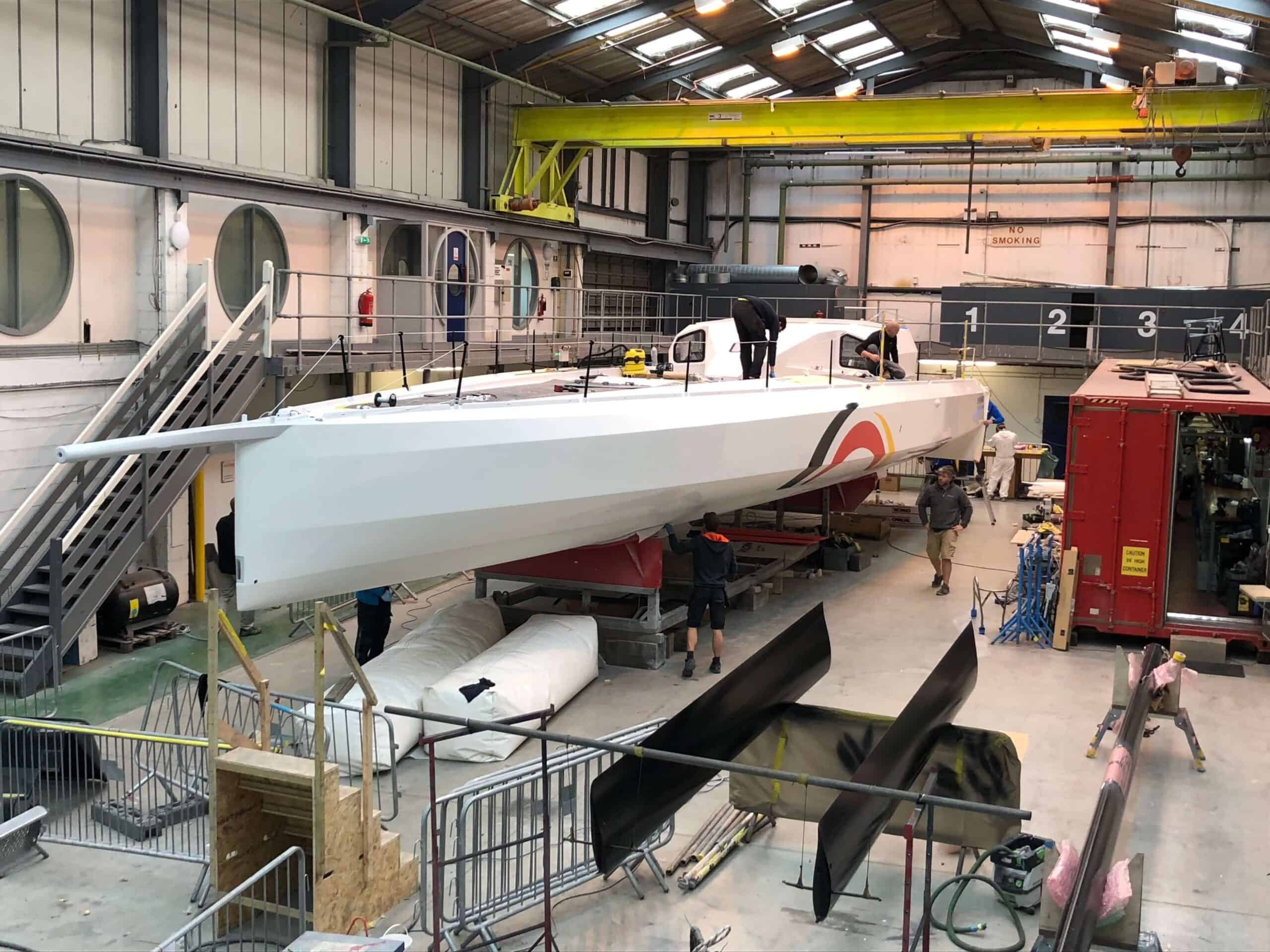
This work complete, the bare structural carcass of Acciona was transferred to Brown’s shipyard in Gosport, UK, in March 2019, for systems fit-out, painting and finishing.

Competitive again
In August 2019, OTG launched its campaign for The Ocean Race 2022-23 with Acciona, now known as Einstein—20 years after a German team last entered and won the race. That same month, Einstein put in a promising performance in the Rolex Fastnet Race. Skippered by Robert Stanjek and navigator Conrad Colman, the yacht finished sixteenth out of field of 390. Even with the old sails and without foils, Einstein proved to be competitive and showed that a crew of five could sail an IMOCA 60 to its potential.
Then, in a tense final race in the summer of 2021 and against all odds, Einstein – which just a few years previously had been gathering dust, battered and broken, in a shed in Mallorca – beat newer, foiling boats to win The Ocean Race Europe overall by one point from 11th Hour Racing. Einstein is, as Kuphal puts it, “in perfect balance.”
This turnaround in fortunes serves as a testament to the talented team of people, whose expertise, dedication and hard work helped to make it possible. Sena echoes the thoughts of many that participated in the project when he says: “It’s been great seeing the boat compete. Knowing where it came from, it’s quite amazing to see it doing so well.”
Julien Sellier, Founder and Managing Director of STRUCTeam, adds: Not only has the team worked to upcycle this large structure, but we have also made it competitive with yachts ten years younger, and as such are more technologically advanced. STRUCTeam is immensely proud to have contributed to this project. We wish the boat every success in the future.”


