

STRUCTeam extends life of a London sewer through the adoption of composites
The King’s Scholars’ Pond sewer rehabilitation was a £20 million construction scheme undertaken beneath one of London’s busiest rail and road districts. STRUCTeam assisted in this challenging repair project that united a range of architectural and design specialists.
Background
In 2009, Thames Water conducted a quality inspection inside a section of a Victorian sewer that lies deep beneath the streets of central London. Significant internal degradation and deterioration was detected within the 170-year-old brick structure. This included significant cracking of the brickwork caused by the settlement of the railway tunnel beneath.
The Challenge
Constructed between 1848-1856, the King’s Scholars’ Pond sewer is located two metres beneath one of the capital’s busiest intersections between Baker Street and Marylebone Road. The wastewater line is supported by a bridge structure that crosses between the walls of the Underground tube tunnel.
Due to the tunnel’s location, closing the Underground to repair this segment of the sewer from below would be hugely problematic and cost an estimated £1 million each day. Equally, closing the junction of Marylebone Road and Baker Street would also have caused major disruption for 5-6 months. The repair solution also needed to keep the existing structure intact, allowing it to remain in full wastewater operation throughout the project.
A multi materials solution
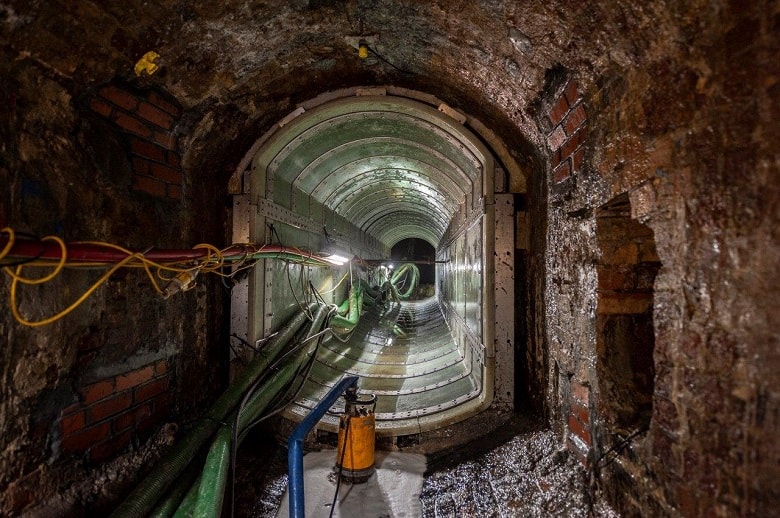
To extend the sewer’s life, a unique and complex keyhole repair process was devised by Thames Water and technical partners, eight²O. This procedure involved the construction of a modular, 9.5 metre duplex stainless-steel bridge truss lined with 58 GFRP (glass fibre reinforced polymer) composite panels. The panels were then secured to the outer frame.
Both the steel structure and interior composite panels were manufactured off site using a detailed modelling system. This allowed the construction teams to visualise the assembly process. The individual components were then lowered underground, a single piece at a time, through a street level maintenance cover measuring 600mm x 750mm. This highly efficient strategy ensured the busy road above remained in constant use with no significant disruption.
The secondary structure, manufactured with composite panels, was also lowered through the same small opening, and attached to the arches of the steel cage. Both structures were then bolted together and sealed to form a watertight bridge within the existing sewer and span the Underground tunnel beneath.
The application of composites and steel provided an exceptionally strong and durable solution. Composites also resist corrosion– an essential consideration in a wastewater environment where pH values and temperatures regularly fluctuate. The liner had to be capable of operating at a pressure of 0.3 bar with no leakage, whilst withstanding external pressure when the sewer was empty.
Independent verification
STRUCTeam has broad experience performing Cat III and independent third-party checks on a variety of high-performance structures. The team has executed multiple high profile wind turbine and civil engineering projects over the past decade. Examples include wind turbine and tidal blades, pedestrian, and vehicular bridges, all of which require rigorous qualification processes.
“This in-depth knowledge of advanced materials and the team’s ability to apply an extremely high level of engineering detail to the KSP sewer project made STRUCTeam our ideal technical partner. We were guided by their composites expertise and the team’s involvement added an additional level of security and quality assurance to the entire process,” Tom Lawlor, Quantity Surveyor, Skanska Utilities/ eight²O.
STRUCTeam was responsible for conducting all the structural checks on the composite panels. This included analysis of load cases, how the panels were secured to the steel structure, and secondary functions including water tightness of the panels.
Adhering to Standards for Highways was also an integral part of the project for STRUCTeam. These guiding principles dictate the UK highways agency best practice for design, construction, and maintenance to ensure all structures are reliable, durable, and most importantly, safe.
However, composites specifications are not included within the Standards for Highways criteria. Indeed, most architects and civil design engineers do not routinely use composites as part of their materials toolkit.
STRUCTeam’s experience within the civil and renewables sectors enabled the KSP sewer project team to benefit from the use of composites in the most effective manner, and in tandem with more traditional materials.
“The KSP sewer project was unique, complex and required an agile approach. Our extensive knowledge in the application of composite technologies in high performance, critical structures made it a challenge we relished and enjoyed,” comments Martin Calmon, Senior Design Engineer at STRUCTeam.
A sustainable outcome
The construction works were completed in May 2019 within both the contracted programme period and target cost.
The rehabilitation of the KSP sewer means the structure should not require any significant maintenance for around 120 years. The composites liner, which has a lifespan of 50 years, has been constructed so the individual panels can be removed to allow the sewer bricks to be inspected in future with minimal disruption.
Thames Water estimates the unique keyhole repairs, combined with the adoption of modular, lightweight materials, meant a significant amount of disruption was avoided. It has also eliminated the need for any large-scale excavations in the future saving 26,443 tonnes of embodied carbon and £23 million.
“The successful delivery of this large-scale construction scheme is thanks to the diligence and proficiency of our all partners. Working with STRUCTeam allowed us to adopt a multi materials approach under the guidance of experienced composites experts.” Asad Hanfi, Project Manager, Thames Water.


